7 Best Night Vision Monocular (October 2026)
The best night vision monoculars include the TOPDON TS004 Thermal Monocular for wildlife spotting, the Bushnell Equinox X650 for property checks, and the YUANZIMOO Night Vision Monocular for camping kits.
On this page (8 sections)
- Which best night vision monocular pick fits your needs?
- How these monoculars were compared
- How do you choose the right image, range and zoom?
- Which power, storage and mounting features matter outdoors?
- How should you set up a night vision monocular?
- Which mistakes shorten useful viewing time?
- How do you clean and store a monocular?
- Which best night vision monocular should you buy?
The best night vision monocular for handheld day and night video is the Bushnell Equinox X650. Our highest-scoring pick, the TOPDON TS004 Thermal Monocular, suits a different job: finding heat sources against cooler surroundings.
Choose the image type before comparing zoom or recording resolution. Digital night vision shows a recognizable scene using available light or infrared illumination, while thermal imaging displays heat differences.
For camping, battery handling and included accessories can matter more than a long range claim. For mounted observation, fit and field of view deserve more attention than the biggest recording number.
Our picks at a glance
-
1
-
2

-
3
- 4
 Check it
YUANZIMOO Head-Mounted Monocular
Best for stationary hands-free viewing - 5
 Check it
GOYOJO GNG2K Night Vision Monocular
Best for helmet-based observation - 6
 Check it
Minolta MNDM10B Night Vision Monocular
Best for travel recording - 7
 Best for stationary thermal scanningCheck it
Which best night vision monocular pick fits your needs?
Choose Bushnell for conventional digital viewing or TOPDON for heat detection. The other picks serve more specific needs, including a ready-to-pack camping kit, mounted viewing and compact recording.
TOPDON TS004 Thermal Monocular
- Thermal imaging
- 256 x 192 IR resolution
- 50Hz refresh rate
- Up to 11-hour battery life
- IP67 protection
Choose this thermal model to find warm subjects against cooler surroundings. Wireless phone viewing helps when you want to share the view or record through an app.
Pros
- Heat detection without IR illumination
- Up to 11-hour claimed runtime
- IP67 protection
Cons
- Heat patterns do not show normal scene colors
- Phone needed for app-based viewing and capture
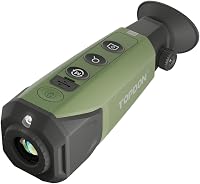
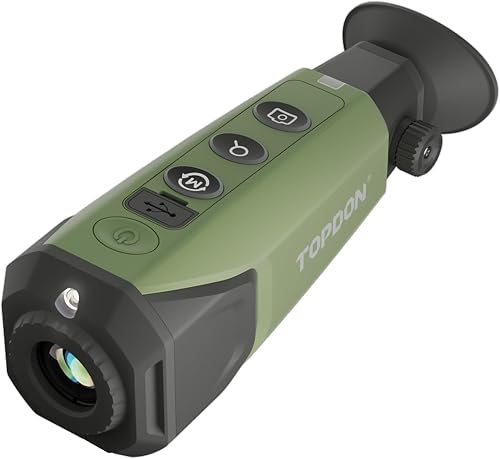
The TOPDON TS004 suits wildlife watchers who first need to locate a warm subject in a dark scene. Its 256 x 192 thermal sensor and 50Hz refresh rate show heat patterns, rather than natural colors or a familiar night vision picture.
TOPDON claims up to 11 hours from the 5000mAh battery. Its silicone-covered body has IP67 protection, making it a better fit for damp outdoor observation than a model that must stay sheltered.
TOPDON gives a detection range of up to 410 m and describes clear detail within 100 yd. Those are different tasks: noticing a heat source at a distance does not tell you what animal it is.
The TopInfrared app supports wireless live viewing, image capture and video with audio, including offline use. That helps if another person wants to watch without passing the monocular back and forth.
Skip it if scene detail is your main goal, such as examining objects around an outbuilding. Read our guide to night vision vs thermal before choosing heat detection over a conventional image.
Bushnell Equinox X650
- Day and night video capture
- Built-in IR illuminator
- 3x optical magnification
- Up to 5x digital zoom
- Tripod-mount adaptor
A straightforward choice for handheld checks and fixed-position video. AA power suits buyers who prefer replacing batteries to waiting for a recharge.
Pros
- Day and night recording
- Built-in IR illumination
- Tripod-mount adaptor included
Cons
- Needs replacement AA batteries
- Memory card capacity and inclusion need confirmation
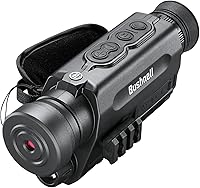
The Bushnell Equinox X650 is the clearest starting point for property checks, campsite observation and handheld wildlife video. It supports daytime and nighttime capture, saving footage directly to a microSD card.
Its 3x optical magnification gives a closer starting view, with up to 5x digital zoom available for enlarging the image. Bushnell claims viewing up to 650 ft in total darkness using the built-in IR illuminator.
Use the included tripod-mount adaptor when watching one patch of ground or a fixed approach. A stable position makes it easier to compare movement in the scene without adding hand shake.
Power comes from 3 AA batteries. That suits longer outings where you can carry replacements, but it adds a recurring packing job if you prefer charging everything by USB.
Choose it when you want a familiar-looking scene and saved video without wearing a mount. Skip it for heat detection or hands-free viewing, and plan your memory card before the first outing.
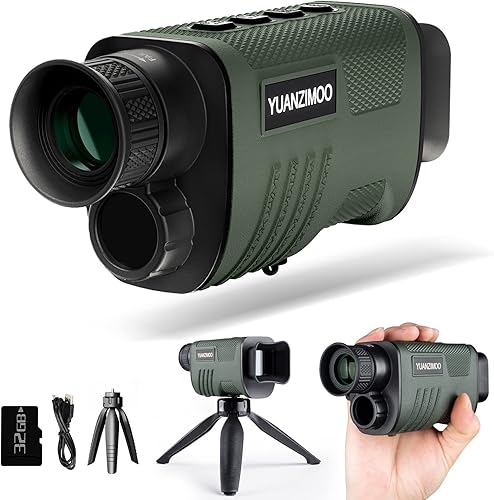
YUANZIMOO Night Vision Monocular
- Rechargeable 2000mAh battery
- Seven IR levels
- 2x optical magnification
- 8x digital zoom
- Tripod and 32GB card included
The included tripod, storage and carrying accessories suit campers assembling their first observation kit. Rechargeable power works with a power bank or car charger.
Pros
- Tripod and storage included
- Adjustable IR illumination
- Power-bank charging support
Cons
- Small screen for reviewing clips
- Digital zoom enlarges existing image detail
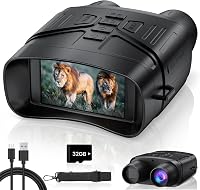
The YUANZIMOO Night Vision Monocular suits campers who want a kit with fewer separate accessories to gather. It includes a tripod, 32GB memory card, straps, storage bag and cleaning cloth.
The 2000mAh rechargeable battery supports charging from a power bank or car charger. That fits trips where you already carry a charging kit, although battery capacity alone does not tell you how long an evening's use will last.
Seven adjustable IR levels let you change illumination for the scene. The optics provide 2x magnification, with 8x digital zoom available, and YUANZIMOO claims viewing up to 984 ft.
Its photo, video and playback modes use a 1.5-inch TFT screen. That screen is useful for framing and checking a clip, while a larger display is better for examining saved details later.
Skip it if you need mounted observation or want a device centered on replaceable batteries. For that second approach, our Bushnell Equinox X650 review explains the alternative.
YUANZIMOO Head-Mounted Monocular
- Head-mounted design
- Rechargeable 2200mAh battery
- Seven IR levels
- 2x optical magnification
- 32GB memory card included
A head-mounted option for observation from a dry, sheltered spot. Choose it only if you can meet its mounting and weather-care requirements.
Pros
- Head-mounted format
- Rechargeable power
- Photo, video and playback modes
Cons
- Must be protected from rain and mist
- Mount fit needs checking
- Avoid drops and impacts
The YUANZIMOO Head-Mounted Monocular is for stationary observation when holding a device becomes inconvenient. Choose it for a dry, sheltered spot where you can adjust the fit before watching.
It has a 2200mAh rechargeable battery, seven IR levels, photo and video modes, and an included 32GB memory card. Power-bank or car-charger charging can fit the same charging routine as other camping gear.
Its 2x optical magnification and 8x digital zoom favor observing a scene rather than preserving your normal unaided view. YUANZIMOO claims viewing up to 984 ft, but mounting does not turn that distance into assured identification.
The care limits are decisive: protect it from rain, mist, drops and impacts, and operate within -5°C to 40°C. A head-mounted format does not remove those restrictions.
Skip it for exposed, wet-weather outings or if you only need quick handheld checks. Read how digital night vision works to understand why illumination and scene conditions still matter.
GOYOJO GNG2K Night Vision Monocular
- 2688 x 1520 resolution
- 60Hz refresh rate
- 940nm IR illumination
- 45-degree field of view
- Helmet mount and compass
The helmet mount and wide field of view suit buyers building a mounted observation setup. Four display modes provide different ways to view the scene.
Pros
- Quick-release helmet mount included
- Wide field of view
- Built-in electronic compass
Cons
- Requires compatible helmet hardware
- No runtime figure supplied
- Digital color modes are not analog image intensification
The GOYOJO GNG2K suits buyers building a helmet-based observation setup. Its 45-degree field of view is a useful starting point for watching a broader scene rather than concentrating on maximum enlargement.
The device combines 2688 x 1520 resolution with a 60Hz refresh rate. Its four viewing modes include night green, black and white, white phosphor and a tinted color mode.
Those names describe digital display choices. The white phosphor mode does not make this an analog image-intensifier device.
A 940nm IR illuminator offers three brightness levels, and GOYOJO claims viewing up to 300 m in total darkness. Do not assume infrared illumination is invisible to other night vision equipment.
The quick-release helmet mount and electronic compass support a mounted setup, but fit still depends on your helmet and hardware. Skip it if you want a simple grab-and-look device, or need a known runtime before planning a long outing.
Keep an independent way to check your surroundings; a mounted monocular and compass do not guarantee safe movement through darkness.
Minolta MNDM10B Night Vision Monocular
- 4K video
- Photos up to 48MP
- 4x digital zoom
- 2.7-ounce weight
- 32GB memory card included
Compact capture and USB-C file transfer make this a travel-focused option. Choose it for portability and recording rather than an established total-darkness range.
Pros
- Lightweight design
- Included and expandable storage
- USB-C charging and file transfer
Cons
- No warranty
- Total-darkness illumination capability needs confirmation
- No runtime figure supplied
The Minolta MNDM10B suits buyers whose main goal is carrying a small recording device. Its 2.7-ounce weight makes portability the reason to consider it alongside these larger observation-focused options.
It captures 4K video and photos up to 48MP, with an integrated IPS display for reviewing content. Those capture figures describe saved files, not a promise of fine detail in darkness.
A 32GB memory card is included, and MicroSD support extends to 128GB. USB-C handles charging and file transfer, which keeps the basic workflow familiar for travel.
The built-in rechargeable battery has an 800mAh capacity. Without a runtime figure, plan charging around your actual use rather than estimating endurance from capacity alone.
Skip it if reliable total-darkness observation is the main reason you're buying. Confirm its illumination capabilities before ordering for that job, and factor in the absence of a warranty.
For a device with a clearly stated built-in IR illuminator, return to Bushnell or either YUANZIMOO option.
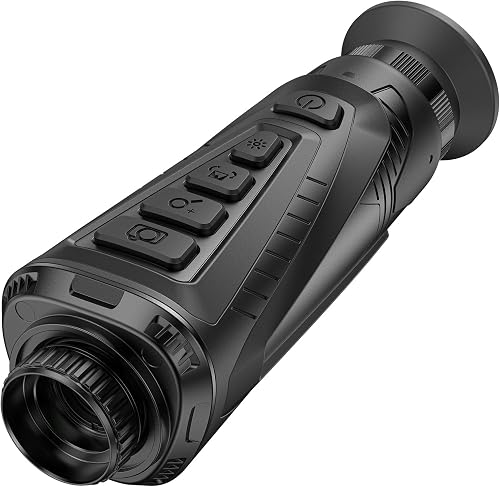
CVLIFE Thermal Monocular
- 256 x 192 thermal sensor
- Six color palettes
- Hotspot tracking
- Built-in 16GB storage
- IP65 protection
Picture-in-picture and hotspot tracking suit buyers who want viewing tools for deliberate thermal scans. WiFi and app support help with sharing and file transfer.
Pros
- Six thermal palettes
- Picture-in-picture and hotspot tracking
- External power support
Cons
- 450g device weight
- Heat images do not replace normal scene detail
- IP65 does not cover immersion
The CVLIFE Thermal Monocular suits deliberate scans from a fixed position. Picture-in-picture and hotspot tracking give you tools for watching a selected area while keeping heat patterns in view.
Its 256 x 192 thermal sensor feeds a 1024 x 768 display. The larger display number does not increase the number of heat measurements captured by the sensor.
Six palettes change how those measurements appear, including white-hot and black-hot views. Start with a simple palette before moving to more colorful options, so you can learn the scene without changing several things at once.
Photo and video capture use built-in 16GB storage, with WiFi and app support for viewing and file transfer. CVLIFE claims up to 8 hours of runtime and supports external power.
The device weighs 450g and has IP65 protection. Skip it if you want natural scene detail or the lightest travel option; read how thermal imaging works if heat patterns are unfamiliar.
How these monoculars were compared
We compared image type, power, recording, protection and mounting needs to judge how each device fits nighttime observation. Scores reflect those features and practical limits, so a higher-scoring thermal model can still be the wrong choice for a digital-viewing task.
Accessories matter when they remove a real obstacle, such as needing a tripod or storage before you can record. High zoom and capture resolution receive less weight when they do not guarantee useful nighttime detail.
For longer sessions with a two-eye viewing format, see the best night vision binoculars. Our night vision binoculars and monoculars guide explains the handling differences.
| Product | Best for | Imaging | Power | Protection | Our score |
|---|---|---|---|---|---|
| TOPDON TS004 Thermal Monocular | wildlife spotting | Thermal, 256 x 192 IR resolution | 5000mAh rechargeable battery; up to 11 hours | IP67 | 8.2 |
| Bushnell Equinox X650 | property checks | Digital day and night viewing | 3 AA batteries | 8.0 | |
| YUANZIMOO Night Vision Monocular | camping kits | Digital with 850nm IR illumination | 2000mAh rechargeable battery | 7.3 | |
| YUANZIMOO Head-Mounted Monocular | stationary hands-free viewing | Digital with 850nm IR illumination | 2200mAh rechargeable battery | 7.0 | |
| GOYOJO GNG2K Night Vision Monocular | helmet-based observation | Digital with four color modes | 6.9 | ||
| Minolta MNDM10B Night Vision Monocular | travel recording | Digital with integrated IPS display | 800mAh rechargeable battery | 6.8 | |
| CVLIFE Thermal Monocular | stationary thermal scanning | Thermal, 256 x 192 sensor | Up to 8 hours; external power support | 6.6 |
How do you choose the right image, range and zoom?
Choose the task and usual distance first, then compare the features that help at that distance. A backyard scan, watching an open field and recording nearby wildlife place different demands on the same device.
Should the best night vision monocular use digital or thermal imaging?
Choose digital to examine a recognizable scene, or thermal to find heat contrast. For example, finding a warm animal near a field edge is different from studying the objects around a shed.
Thermal needs a temperature difference between a subject and its surroundings. Warm ground and other warm surfaces can make interpretation harder, so a bright shape is a clue to inspect rather than an automatic identification.
Neither technology sees through solid walls, and thermal does not see through dense vegetation. Gaps between leaves can expose part of a warm subject, but blocked areas remain blocked.
Digital night vision can need IR illumination when ambient light is insufficient. Our explanation of how digital night vision works covers that relationship.
How much weight should you give a range claim?
Use range claims as broad context, not as your working identification distance. Detecting something, recognizing its general shape and identifying exactly what it is require increasing amounts of detail.
An open area with a clear view is different from a damp yard full of branches. Weather, subject size, background contrast and focus all affect what you can make out.
Plan around your common viewing distance rather than the farthest point you might occasionally inspect. If identifying a subject matters, do not act on an unclear image.
Does optical magnification matter more than digital zoom?
Optical magnification matters more for the starting view; digital zoom enlarges the captured image. Electronic enlargement can help you inspect a shape, but it cannot recover detail that the sensor never captured.
Start at the lowest available zoom when scanning. Once you locate a subject, stop moving, focus and enlarge only as much as needed.
Higher magnification also makes hand movement more obvious and reduces the scene you can watch. For nearby activity, keeping the animal in view can be more useful than making it fill the screen.
Which resolution number should you compare?
Compare sensor resolution with sensor resolution, and keep display and recording figures separate. A high-resolution screen can make viewing more comfortable without adding information to the original image.
The same distinction applies to large photo files. More saved pixels do not by themselves prove better low-light detail, so choose recording features around how you will use the footage.
Which power, storage and mounting features matter outdoors?
Choose power you can replenish and controls you can manage in darkness. A device that fits your charging routine and viewing position is more useful than extra features you rarely use.
Should you choose AA batteries or rechargeable power?
Choose replaceable batteries when quick swaps fit your trips, or rechargeable power when you already carry a charging source. Pack the correct spares or cable before leaving.
Do not compare battery capacities across different devices as though they were runtime figures. Displays, illumination, recording and wireless connections place different demands on power.
An “up to” runtime is a planning ceiling, not a promise for every setting. Leave enough reserve to finish the observation session and pack up.
Do you need recording and wireless viewing?
Recording matters if you want to review a sighting, compare activity across evenings or share a clip. If you only want brief visual checks, storage and transfer features should carry less weight.
Check that the memory card is recognized before going outside, and play back a short clip. A recording icon is not enough if the file cannot be saved or opened.
Wireless viewing is useful for sharing a thermal scene with another person. Download the app and complete the connection at home, so account setup or phone settings do not interrupt the outing.
Is handheld or mounted viewing the better fit?
Choose handheld for quick stops and mounted viewing for longer observation from a settled position. A tripod can offer a useful middle ground when you want a steady view without wearing the device.
For head or helmet mounts, check attachment compatibility, eye position and balance before committing to the setup. Also make sure you can reach the controls without shifting the view.
A monocular display changes how you judge distance and your surroundings. Stop observing through it before dealing with uneven ground, steps or other obstacles.
How much weather protection do you need?
Choose protection that matches the conditions you actually expect. A dry porch, humid campsite and exposed field are different environments.
IP65 protection does not cover immersion, while IP67 also has defined limits. Neither designation is a reason to leave a wet device in its bag or charge it while damp.
A model with instructions to avoid rain and mist belongs in sheltered use. Do not substitute an outdoor-looking body or a head mount for an explicit protection level.
How should you set up a night vision monocular?
Set up power, focus, storage and illumination before the first night out. Learning the controls in daylight leaves fewer adjustments to solve when a subject appears.
- Prepare power and storage. Charge the device or fit the correct batteries, then insert any required memory card according to the manual.
- Learn the controls. Locate power, focus, IR brightness, zoom and recording without needing to search for each button.
- Adjust the view. If an eyepiece adjustment is provided, make display text clear first, then focus on the subject.
- Start wide. Use the lowest zoom and a familiar scene with objects at different distances.
- Add IR gradually. On a digital model, raise illumination only until the scene is useful rather than choosing maximum output automatically.
- Save and review a clip. Check focus, framing and playback before relying on the device for an outing.
At night, aim past nearby branches when possible. Close leaves can reflect IR brightly and leave the more distant scene harder to see.
For digital viewing, use an open sightline instead of aiming through a window with IR switched on. Infrared reflected from glass can wash out the view.
For thermal viewing, start with white-hot or black-hot and watch familiar objects cool after sunset. That helps you learn which shapes belong to the background before searching for wildlife.
Use only the daylight mode and instructions appropriate to your device. Our guide to using digital night vision during the day explains the distinction.
Which mistakes shorten useful viewing time?
The biggest mistakes are too much zoom, too much illumination and rushed focus. Correct those before deciding that a distant subject needs a different device.
A bright screen can make the surrounding darkness harder to see when you look away. Use a comfortable display level, pause between scans and keep ordinary lighting available for packing up.
Do not chase every thermal hotspot or assume that a bright IR reflection identifies an animal. Hold the view steady and look for enough shape and movement to understand what you are seeing.
Avoid spending the entire outing recording or adjusting palettes. Set a simple default view, then change one setting when the scene gives you a reason.
For wildlife, observe from a distance and avoid using the device as a reason to approach. A closer position can disturb the subject without solving poor focus or a blocked view.
How do you clean and store a monocular?
Keep grit off the lenses and moisture out of storage. Fit the lens cap when the device is packed, and let damp gear dry before closing it inside a bag.
Remove loose dust before wiping optical surfaces. Use a clean lens cloth and only cleaning methods suitable for the lens coating; rubbing grit across glass can scratch it.
Dry the body before opening covered ports or connecting a charger. Keep cables and cards clean too, especially after use around dirt or sand.
Follow the device's battery-storage instructions during long breaks. Keep rechargeable equipment away from heat, and follow the manual's guidance on periodic charging or removing replaceable batteries.
Which best night vision monocular should you buy?
Choose Bushnell Equinox X650 for handheld digital observation, or TOPDON TS004 for finding heat sources. That image choice matters more than the order of the scores.
Pick the handheld YUANZIMOO for a camping kit with storage and a tripod. Choose its head-mounted sibling only for a compatible, sheltered setup, or GOYOJO when a helmet-based view is central to your plans.
Minolta fits compact recording, while CVLIFE fits deliberate thermal scans with extra viewing tools. Skip either if its main strength does not solve your usual observation task.
Before buying the best night vision monocular for your needs, decide what you must recognize at your normal viewing distance. Use our night vision vs thermal guide to settle the image choice, then match power and mounting to your trips.
Our top 3 picks at a glance
-
1
-
2
-
3
Frequently asked questions
What is the difference between night vision and thermal monoculars?
Digital night vision forms a scene using ambient light or infrared illumination, while thermal monoculars show heat differences; choose digital for observing shapes and surroundings, or thermal for finding warm subjects against cooler backgrounds. Neither technology guarantees identification at its longest claimed range, and neither sees through solid objects.
Can a night vision monocular be used during the day?
Some digital night vision monoculars support daytime use, including the Bushnell Equinox X650 and both YUANZIMOO models here; follow the instructions for your exact device and its daylight settings. Do not apply digital-device guidance to analog equipment, and never point any monocular at the sun.
Is a head-mounted night vision monocular better?
A head-mounted monocular is better when keeping your hands free during observation matters more than quick handheld use; fit, balance and mount compatibility become part of the buying decision. A mounted display restricts your natural view, so the mount alone does not make walking, climbing or driving safe.
How much zoom should a night vision monocular have?
Choose enough optical magnification for your usual viewing distance, then use digital zoom only when it helps inspect an image; higher zoom narrows the area you can watch and makes shake more obvious. For nearby wildlife or property scans, a usable field of view matters more than the largest zoom number.
Are night vision monoculars legal to own?
Check current rules for your location and activity before buying or using night vision equipment; ownership, hunting, surveillance and crossing borders can involve different requirements. Our guide to night vision goggles laws explains which questions to take to the relevant authorities, including rules for your intended use.